项目背景
场景
- 需要为员工批量注册系统账号
- 从
users.txt读取姓名列表 - 调用 Admin API 创建用户
技术栈
- Python 3.9
- pypinyin(中文转拼音)
- requests(HTTP请求)
API
POST /api/v1/admin/users
输入
users.txt(中文姓名)
输出
accounts.txt(账号密码)
原始需求
用户向 AI 提出的原始需求
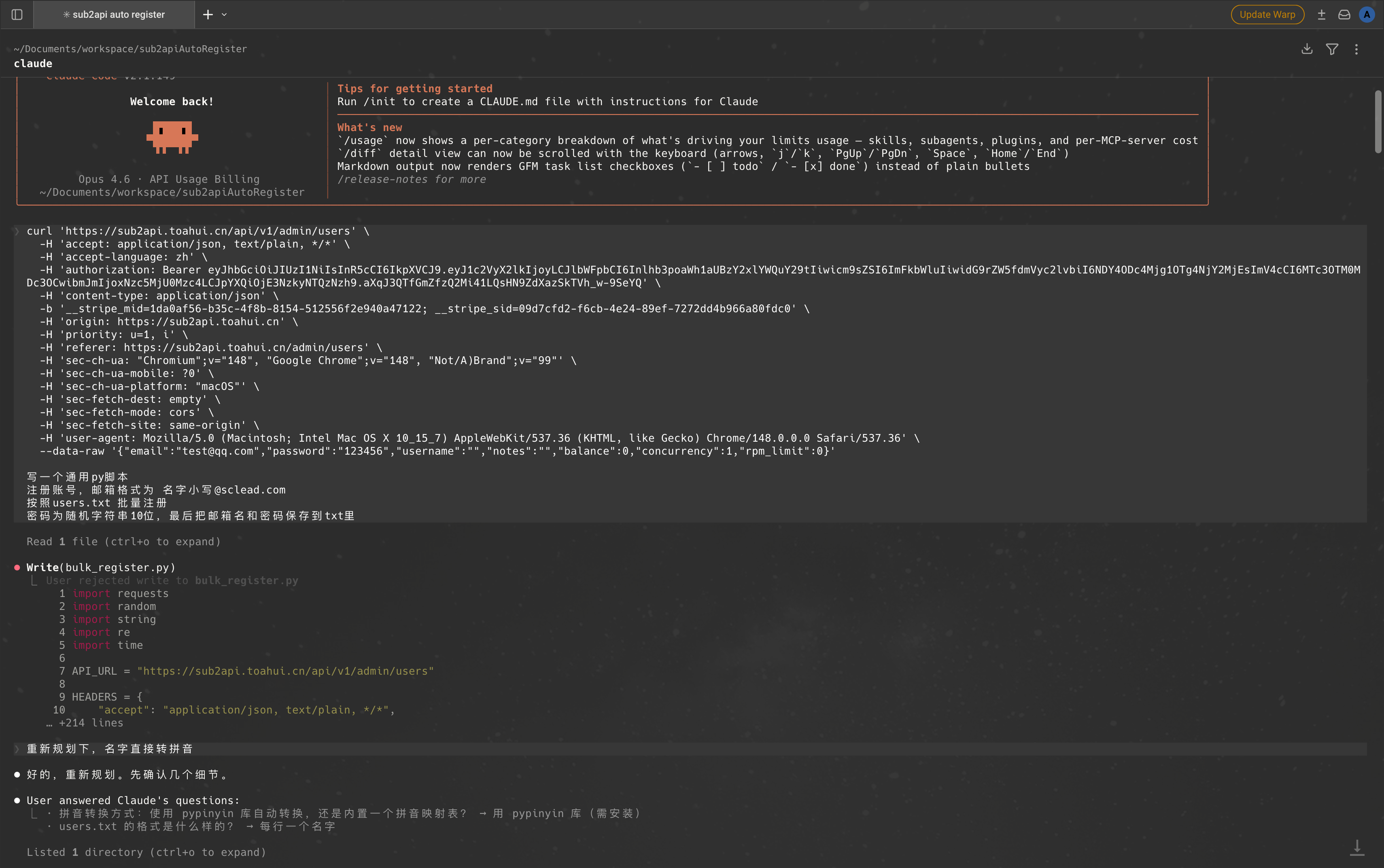
问题需求
需要转换为可复用的自动化脚本
1. 中文名 → 拼音 → 邮箱前缀
2. 随机生成10位密码
3. 批量调用API注册
4. 结果保存到文件
1. 自动备份已有结果文件
2. 结果中加原中文名
原始请求
用户提供的 curl 命令
curl 'https://sub2api.toahui.cn/api/v1/admin/users' \
  -H 'accept: application/json, text/plain, */*' \
  -H 'authorization: Bearer eyJhbG...SeYQ' \
  -H 'content-type: application/json' \
  --data-raw '{"email":"test@qq.com","password":"123456",
               "username":"","notes":"","balance":0,
               "concurrency":1,"rpm_limit":0}'
问题 手动执行14次?改14次email和密码?不可扩展
V1:初始版本
AI第一版输出:手写拼音映射表(部分)
pinyin_map = {
    '姚': 'yao', '志': 'zhi',
    '张': 'zhang', '伟': 'wei', ...
}

def chinese_to_pinyin(name):
    result = []
    for char in name:
        if char in pinyin_map:
            result.append(pinyin_map[char])
        else:
            result.append(char.lower())
    return ''.join(result)
缺陷 200+行硬编码映射,遇到生僻字直接跳过,维护困难
改进 1:使用 pypinyin 库
Before:200+行映射
pinyin_map = {
    '姚': 'yao',
    '志': 'zhi',
    '张': 'zhang',
    # ... 200+ 行
}
After:3行代码
from pypinyin import lazy_pinyin

def name_to_pinyin(name):
    parts = lazy_pinyin(name)
    return "".join(parts).lower()
收益 代码从200+行降到3行,支持所有汉字,零维护成本
改进 2:自动备份
用户反馈:结果保存时,如果有记得备份
import os
from datetime import datetime

output_file = "accounts.txt"
if os.path.exists(output_file):
    ts = datetime.now().strftime("%Y%m%d_%H%M%S")
    backup = f"{output_file}.{ts}"
    os.rename(output_file, backup)
    print(f"旧文件已备份: {backup}")
效果
accounts.txt.20260523_095533
每次运行自动保留历史记录,不怕数据丢失
改进 3:结果加中文名
用户反馈:结果第一列加上原中文名
Before
yaozhi@sclead.com 0xDvfMN55l 成功After
姚志 yaozhi@sclead.com RgKB9O4n2Q 成功# 核心改动:results 存储时加入 name
results.append((name, email, password, "成功"))
# 写入时输出4列
f.write(f"{name}\t{email}\t{password}\t{status}\n")Bug 解决 1:类型注解兼容性
Python 3.9 不支持 | 联合类型语法
错误代码
def register_user(email: str, password: str)
        -> tuple[int | None, str]:
    ...
TypeError: unsupported operand type(s) for |: 'type' and 'NoneType'
修复后
def register_user(email, password):
    ...
移除类型注解,兼容 Python 3.9
教训 AI生成代码时默认使用最新Python语法,需确认运行环境版本
Bug 解决 2:元组解包错误
改了数据结构,忘了改统计代码
错误代码
# results 已改为 (name, email, pwd, status)
results.append((name, email, password, "成功"))

# 但统计还是按3个元素解包
success = sum(1 for _, _, s in results if s == "成功")
# ValueError: too many values to unpack
修复后
# 改为4个元素解包
success = sum(1 for _, _, _, s
    in results if s == "成功")
教训 修改数据结构时,确保所有使用该结构的地方同步更新
最终代码
#!/usr/bin/env python3
import os, secrets, string, time
from datetime import datetime
import requests
from pypinyin import lazy_pinyin

API_URL = "https://sub2api.toahui.cn/api/v1/admin/users"
HEADERS = { ... }  # Authorization + Content-Type

def generate_password(length=10):
    chars = string.ascii_letters + string.digits
    return "".join(secrets.choice(chars) for _ in range(length))

def read_names(filepath):
    with open(filepath, "r", encoding="utf-8") as f:
        return [line.strip() for line in f if line.strip()]

def name_to_pinyin(name):
    return "".join(lazy_pinyin(name)).lower()

def register_user(email, password):
    payload = {
        "email": email, "password": password,
        "username": "", "notes": "",
        "balance": 9999, "concurrency": 20, "rpm_limit": 0
    }
    resp = requests.post(API_URL, headers=HEADERS, json=payload, timeout=30)
    return resp.status_code, resp.text

def main():
    names = read_names("users.txt")
    results = []
    for name in names:
        email = f"{name_to_pinyin(name)}@sclead.com"
        password = generate_password(10)
        status, text = register_user(email, password)
        results.append((name, email, password,
            "成功" if status == 200 else f"失败-{status}"))
        time.sleep(0.5)

    # 自动备份
    if os.path.exists("accounts.txt"):
        ts = datetime.now().strftime("%Y%m%d_%H%M%S")
        os.rename("accounts.txt", f"accounts.txt.{ts}")

    with open("accounts.txt", "w") as f:
        for r in results:
            f.write(f"{r[0]}\t{r[1]}\t{r[2]}\t{r[3]}\n")

if __name__ == "__main__":
    main()
运行结果
终端输出
共读取到 14 个用户,开始注册...

注册: 陈云虎 -> chenyunhu@sclead.com
  失败 [409]: email already exists
注册: 黄水清 -> huangshuiqing@sclead.com
  失败 [409]: email already exists
...
旧文件已备份: accounts.txt.20260523_095910
完成!成功: 0/14
结果已保存到 accounts.txt
accounts.txt
陈云虎	chenyunhu@sclead.com	RgKB9O4n2Q	失败-409
黄水清	huangshuiqing@sclead.com	VeyGwbpB2G	失败-409
刘明升	liumingsheng@sclead.com	uEkpQjBwMI2	失败-409
...
姚志	yaozhi@sclead.com	0xDvfMN55l	成功
注意 409 = 邮箱已存在(正常,因为账号之前已注册过)
总结建议
提供输入/输出示例、API文档、边界条件,减少猜测
先跑通MVP,再逐步添加功能(备份、格式优化)
AI生成的代码需要实际运行验证,环境差异会导致bug
pypinyin 替代手写映射,用成熟方案而不是造轮子
确认Python版本,避免使用不支持的语法特性
效率对比
AI不是替代程序员,而是让程序员专注于
需求理解、
架构设计、
业务逻辑
而不是语法细节